 In my last post I talked about lean in the professional kitchen, especially the impact of Auguste Escoffier on modern kitchen management. In this post I will look at the history of the home kitchen, where lean also made some significant changes that you still can see today (albeit some other improvements have been lost). And, one interesting fact for this post: It was all women who made these improvements!
Before the Modern Kitchen
 Before 1900, kitchens were a very rustic affair. The center of the kitchen was the open fireplace. Preparation work was done on a table, which was also often used to eat. There was not much need for storage, as a normal family simply did not have the money for optional stuff. The equipment was usually only the bare-bone necessities. As a result, there was not much storage need either. Often, the few tools were hung at the wall. Where to put the bread maker and where you stored the chocolate fountain were just not problems. The kitchen also often doubled as the living room.
 As technology progressed, the open fireplace was replaced by a enclosed stove, making it much less messy and more fuel efficient. Increased prosperity allowed for more stuff, and shelves were needed to store these new riches. Running tap water became more common in the cities, as did electric light. The picture here shows a typical Victorian kitchen from 1911. Most of the work was done on the central table. No thought was given on efficiency and ergonomics, albeit cleanliness started to improve.
First Organization: Catharine Beecher
 Catharine Esther Beecher (1800–1878), sister of Harriet Beecher Stowe, the author of Uncle Tom’s Cabin, was a strong advocate and pioneer of women’s education. She studied and optimized kitchens and was the first to argue for an organized layout and arrangement of kitchens. She publishing two books in the subject: A Treatise on Domestic Economy in 1841 and The American Woman’s Home in 1869.
Analyzing the movement in the kitchen, she made fundamental changes. Traditionally, a kitchen had a table in the center and storage at the wall. Beecher removed the table completely and provided working spaces along the wall instead… which is probably the design you still have in your kitchen.
She also set up distinct areas in the kitchen for preservation, storage, cooking, and serving, a setup that is no longer followed nowadays. However, despite her achievements for women, you could not call her a feminist, as she was opposed to women having political power, which she considered evil.
Efficiency Improvements: Christine Frederick

 Christine Frederick (1883–1970) applied Taylorism to the kitchen. She looked at walking distances, conducted experiments, and wrote books on these subjects. She standardized the height of kitchen counters, studied hosuehold appliances for their actual savings on work and effort, and conducted motion studies on kitchen work.
The image on the right shows, for example, the vegetable-cleaning station, with scraps disposed in a bucket underneath right away, albeit she also observed that the hole in the table here was too big and should be only “about eight inches.”
Below are two illustrations from her book The New Housekeeping, showing sort of a spaghetti diagram of walking distances in a bad and a good kitchen layout. The latter has a separate route for preparing the food, and for cleanup after dinner.

The Kitchen Triangle: Lillian Gilbreth
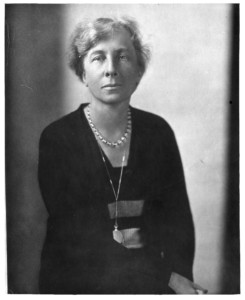

Lillian Gilbreth (1878–1972) , an expert on motion studies, also studied kitchen layout and wrote a book, Management in the Home. She realized that most of the work revolved around three hubs: the refrigerator (or generally, the storage); the sink (preparing and cleaning), and the stove (cooking). Hence, the three points of this triangle should be close together, and with no obstructions in between. She also designed an energy-saving kitchen for the model house America’s Little House in New York in 1930.
The Bauhaus Kitchen by Benita Koch-Otte

Benita Koch-Otte (1892–1976) was a German weaver and textile designer who trained at the Bauhaus. For the 1923 Bauhaus Exhibition in Weimar, Germany, Benita Otte collaborated with Ernst Gebhardt to design “a highly functional kitchen” for the Haus am Horn model house in Weimar, by Georg Muche. This kitchen (shown below) looks pretty much like a modern kitchen design. It was one of the inspirations for Margarete Schütte-Lihotzky for the Frankfurt kitchen, especially the specific storage and drawers for specific items.

The Frankfurt Kitchen by Margarete Schütte-Lihotzky
 Margarete Schütte-Lihotzky (1897–2000) was an Austrian architect, and was hired to design, among many other things, the kitchens in the “Neues Frankfurt” project, a public housing project in Frankfurt, between 1925 and 1930. Based on the works of Taylor, she analyzed the kitchen, aiming for a minimum space (public housing, after all) to offer maximum comfort and equipment in the kitchen. Her final design was a mere 1.9 by 3.4 meters, 10 000 of which were then mass-produced. This is the grandfather… ah, sorry… grandmother of the modern fitted kitchen, the first kitchen in history built after a unified concept.
The kitchen was a narrow double-file kitchen. One short wall had the door, the other the window. Along the left side, the stove was placed, followed by a sliding door connecting the kitchen to the dining and living room. On the right wall were cabinets and the sink, and in front of the window a workspace. The tight space not only saved cost on the floor plan, but also required less movement between stations (even factories nowadays are usually more efficient if space is tight). Like the Haus am Horn, it had labeled storage bins as well as a waste drawer. The kitchen was painted blue, since supposedly flies don’t like color blue.

The Frankfurt kitchen is the prototype for the modern kitchen. This is not to say everybody was happy with it. The kitchen fit only one person, and a second person or a child made the space too tight. The drawers were also easily reachable by small children, leading to lots of spoiled goods. Nevertheless, the design was a huge success (albeit during wartime Germany it was seen as too luxurious).
The Kitchen Island as Part of the Family: Charlotte Perriand

The modern kitchen was usually a separate room for the (usually) woman to work while the rest of the family enjoyed themselves. Nowadays, an open kitchen, often with a kitchen island, merges the kitchen with the living room, and the work in the kitchen is part of the social interaction and no longer excluded in a separate room. I like this much more! The idea of such a kitchen island comes (probably) from Charlotte Perriand (1903–1999), who designed the prototype kitchen for Le Corbusier’s Unité d’Habitation apartment building in Marseille.
Nowadays, modern kitchens still have many of the aspects of the Frankfurt kitchen and its predecessor, albeit the placement of the different equipment and tools is now often less optimized. In general, the drive to optimize the workspace in the kitchen that happened between 1870 and 1940 is no longer there. Instead, we now have internet-enabled refrigerators (to show you advertising) and stoves (where you need an app on your phone to set a timer). Ugh! In any case, now, go out, enjoy a meal with your family or friends in your home, and organize your kitchen… ahem… industry!
Discover more from AllAboutLean.com
Subscribe to get the latest posts sent to your email.