 I have written a lot about leveling and the value of fluctuation in previous blog posts. In this post I will show quantitatively what the benefit of reduced fluctuations is for Denso, part of the Toyota group and a supplier to many other car makers too.
Cost
How to Do Make-or-Buy
 In my last post I discussed how a purely cost-accounting-driven make-or-buy decision can be bad for the company. However, there are often good reasons to buy parts or products instead of make them. In this post I will look at a couple of reasons for outsourcing rather than making it yourself. Unfortunately, all of these are hard to pin down in numbers, and at the end of the day it is still a qualitative decision.
Make or Buy: How Not to Do It
 “Make or buy?” is a question most companies have to ask themselves. Which parts or even products should you make yourself, and which ones should you outsource to a third-party supplier? The question itself is already difficult, but here again we run into the problem of cost accounting. If you go purely by the numbers, you can easily run your company into the ground. Let me show you how (NOT) to do it.
Relation between Quantity and Cost in Manufacturing
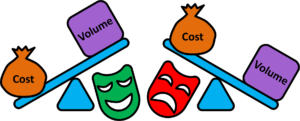 As you surely know, it is more efficient to produce larger quantities. This is the economy of scale. In a recent post I talked about the Power of Six, a rule of thumb for the relation between lead time and cost. In this post I will show you a rule of thumb for the relation between quantity and cost. Credit for this rule goes to Juan Carlos Viela.
The Power of Six: Time and Money for Parts of Your Value Stream
 In my last post I presented you Rajan Suri’s Power of Six – the relation between turnaround time and product cost. In this post I extend his work to apply it to not the entire value stream but to segments of the value stream. Enjoy!
The Power of Six: Relation between Time and Money in Manufacturing
 Time is money. You know that. But with respect to product cost and lead time, there is a rule of thumb that estimates this relation. Let me present to you the “Power of Six,” discovered by Rajan Suri. This gives you a rough estimate of how the lead time of your products influences the cost and vice versa. This first post looks at the original work, and my next post applies this rule also to segments of the value stream.